
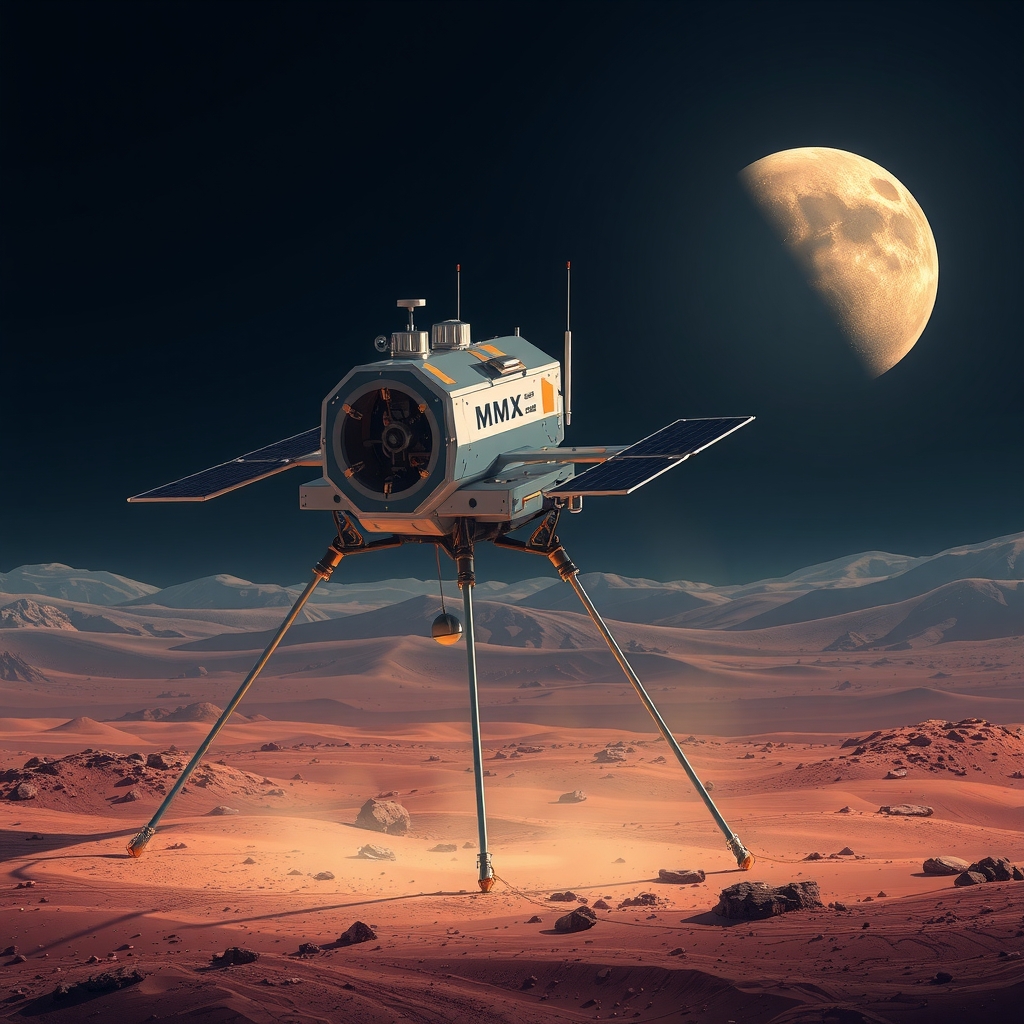
NASA is playing a pivotal role in the Martian Moons eXploration (MMX) mission of the Japan Aerospace Exploration Agency (JAXA). The mission’s primary goal is to characterize Mars’ moons, Phobos and Deimos, determine their origins, and return a sample of Phobos to Earth.
The MMX spacecraft will launch from Tanegashima Space Center in Japan at 3:41 p.m. EDT on Monday, Oct. 19 2026 (4:41 a.m. JST on Tuesday, Oct. 20 2026). After arriving at Mars in August 2027, it will begin a detailed survey of the two moons. Sample collection from Phobos’ surface will not occur until December 2028, and the sample will be returned to Earth in 2031.
NASA’s contributions are multifaceted. The MEGANE spectrograph, developed by the Johns Hopkins Applied Physics Laboratory, will be mounted on one of the spacecraft’s landing legs. It will measure neutrons and gamma rays emitted from Phobos’ surface to determine its chemical composition and provide clues to its origin.
NASA also supplies the Pneumatic Sampler (P‑Sampler), a technology demonstration developed by Honeybee Robotics, a Blue Origin company. This system collects surface material using high‑pressure nitrogen bursts, complementing JAXA’s C‑Sampler, which extracts cores a few inches deeper.
In addition, NASA provides communications and navigation support from its Deep Space Network and funds U.S. scientists on the MMX science team. It will curate about 15 % of the returned sample at the Johnson Space Center Astromaterials Lab in Houston, making it available for research for decades.
NASA leaders have underscored the importance of this partnership. Nicky Fox, associate administrator of the Science Mission Directorate, said the NASA‑JAXA sample curation partnership is extremely valuable. Tom Statler, MMX program executive, added that understanding the origins of Phobos and Deimos will illuminate the early history of the inner planets.
This mission, funded under NASA’s Discovery Program managed by the Marshall Space Flight Center, represents a major advance for planetary science and paves the way for future human exploration of Mars.